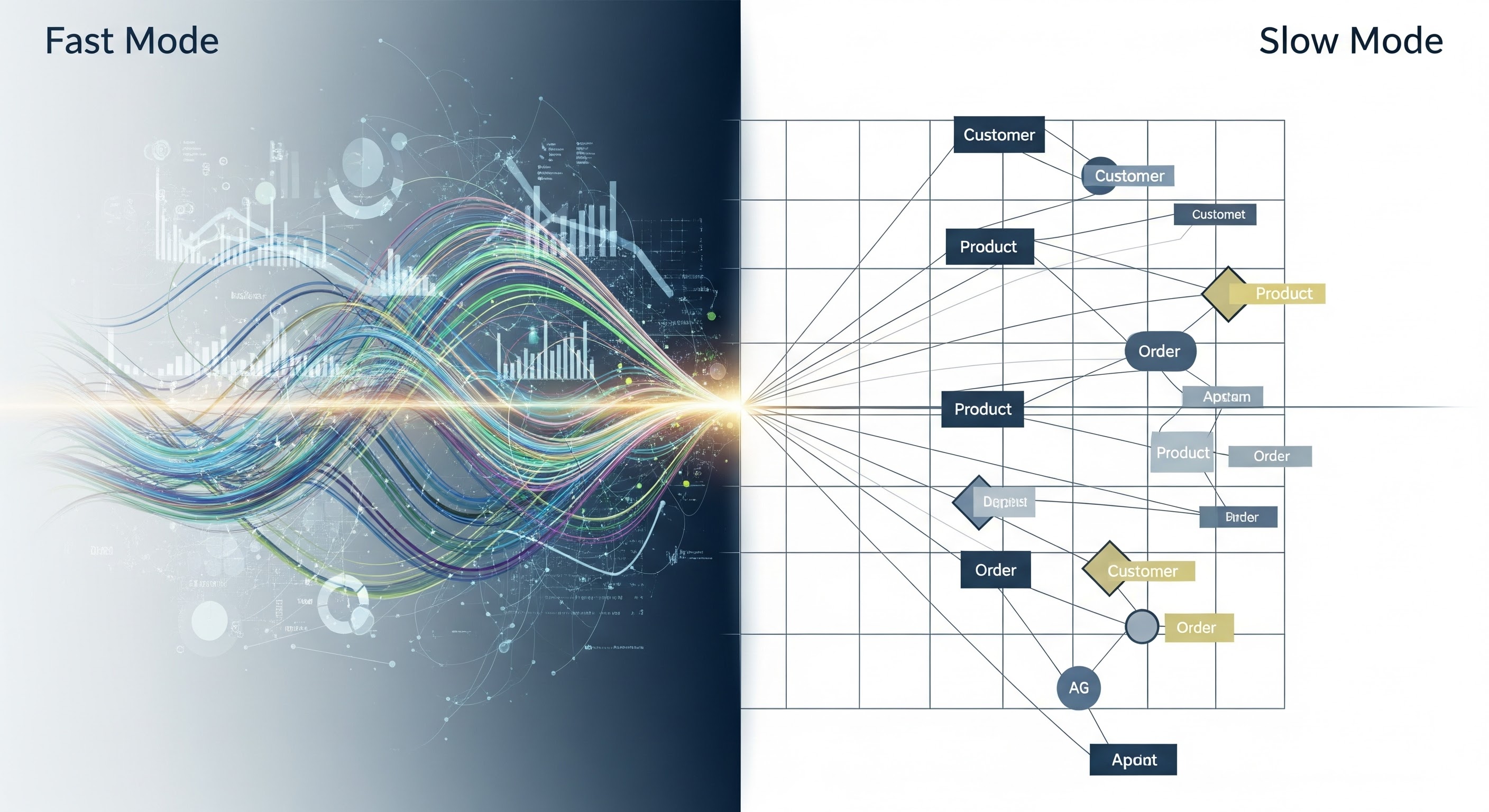

Data modeling has a reputation for being slow, complex, and overwhelming. Many people associate it with painstaking diagrams, rigid methodologies, or deep technical knowledge. But modeling at its core is simply the act of defining what your business means and every team already does this informally. The challenge is making the formal process intuitive and accessible.
By borrowing principles from the cognitive framework outlined in Thinking Fast and Slow, we can redesign how modeling feels. Instead of being a high-friction, high-stakes activity, it becomes a natural habit. This mindset reflects a powerful truth. Modeling does not have to be heavy. With the right approach, it can become the easiest step in the data workflow.
In this article, we explore how applying fast and slow thinking transforms modeling from a heavy task into a natural, confidence-building part of everyday data work.
Your Brain Has Two Modes. Good Modeling Takes Both.
Human decision-making operates through two complementary systems. Fast Mode handles instincts, quick judgments, and immediate actions whereas Slow Mode handles deeper analysis, structured reasoning, and deliberate thought. Most organizations treat modeling as if it belongs entirely in Slow Mode. They assume it must be done perfectly from the start, that every detail must be thought through upfront, and that only experts can participate. This mindset makes modeling feel heavy, complex, and inaccessible.
The best modeling uses both modes in tandem. Fast Mode helps people get ideas out of their heads quickly, sketch early structures, and create momentum and slow Mode comes in once the basics are in place to add clarity, precision, and governance. When teams are allowed to move between these modes naturally, modeling becomes far easier because they aren’t forced into deep reasoning before they understand the big picture.
This blended approach is what makes modeling intuitive. It mirrors how people already think, and it reduces the cognitive load that usually makes modeling feel intimidating. If your fast brain has already led you into choosing a modeling tool that didn’t work out, you’re not alone. The difference with Ellie.ai is that it is built on deep research, thoughtful design, and a model-first philosophy that supports both quick exploration and long-term rigor. You can commit with confidence knowing the platform is intentionally designed to grow with you, not constrain you.
Fast Mode
The hardest part of modeling is often the beginning. Blank canvases create hesitation, unclear instructions slow progress, and many people fear making the “wrong” decision before they even begin. Fast-mode thinking removes this friction by giving teams a simple, intuitive entry point and the confidence to move quickly.
Fast-mode modeling is ideal for:
When modeling supports fast-mode thinking, people no longer freeze at the first step. Ellie.ai streamlines this phase with simple prompts, clean visual design, and lightweight interactions that feel as natural as sketching ideas on a whiteboard.
Slow Mode
Once a basic structure is in place, teams can shift into slow mode, where deeper reasoning and refinement take center stage. Slow-mode thinking brings clarity and accuracy to the model, allowing teams to define the details that truly shape the semantics of the business.
Slow mode is where:
Unlike fast mode, this stage is not about speed or momentum. It is about precision, alignment, and making sure the model accurately reflects how the business works. Ellie.ai supports slow-mode thinking with structured guidance, validation features, and governance-aware modeling tools that help teams refine models confidently, without feeling like you’re starting from scratch.
Why Switching Between Modes Matters
The real value emerges when teams can move between fast and slow modes seamlessly. Fast mode provides momentum; slow mode brings confidence and precision. Together, they create clarity without cognitive overload. When modeling becomes a continuous activity rather than a large, intimidating task, teams stop viewing it as something to revisit quarterly and start treating it as a natural part of everyday decision-making.
No Resistance or Fear. Just a Clear Path into the Data
The real goal of blending fast and slow thinking isn’t just efficiency, it’s reducing the fear, friction, and hesitation that have historically made modeling feel intimidating. When teams know they can start quickly, refine gradually, and course-correct without penalty, the resistance disappears. Modeling becomes a source of clarity rather than anxiety.
This is where Ellie’s design philosophy truly matters. The platform doesn’t force users into complexity before they’re ready. Instead, it draws people in with intuitive starting points, clean visuals, and simple next steps. They begin modeling because it feels natural, not because a process checklist told them they had to.
With that psychological barrier removed, modeling turns into an inviting step in the workflow. It isn’t heavy, slow, or something only experts can touch. It’s a clear, confident path into understanding the business.
Turning Modeling into a Low-Friction Daily Practice
The biggest long-term benefit of treating modeling as a regular practice rather than a one-off project is consistency. When the modeling process is easy to start, simple to update, and genuinely useful day to day, it becomes intuitive.
Building modeling into your daily workflow means your team can:
Ellie.ai is built to support this kind of frictionless, ongoing modeling. Key capabilities that enable data modeling to become a daily practice include:
When modeling becomes this accessible and collaborative, it stops being an occasional chore and becomes a natural part of how teams work. This prevents the technical debt that comes from inconsistent semantics and turns modeling into a strategic capability that supports agility, confidence, and long-term growth.
Why Modeling Should Be the Starting Point
Even when modeling feels intuitive and fits naturally into daily work, its greatest impact comes from where it begins. Starting with meaning before analytics, orchestration, or AI prevents the downstream confusion that occurs when teams build without a shared understanding of what the data represents. When teams start with modeling, they stop correcting yesterday’s misunderstandings and start designing tomorrow’s systems with confidence.
Making modeling the starting point does not require a major process overhaul. It simply means beginning with meaning before moving into technical design or analytics. This can be achieved by following a few simple steps:
Ellie.ai: Clarity Without the Cognitive Load
Modeling should not feel like a high-stakes technical exercise. When teams use both cognitive modes, the process becomes natural. Fast mode gets ideas out quickly and slow mode adds clarity and structure. Together, they create models that are accurate and intuitive without overwhelming the people doing the work.
This is the shift modern teams need. With Ellie.ai, this shift is easy. The platform supports both fast and slow thinking, helping teams define meaning quickly and refine it as they go, turning modeling into a seamless part of the workflow rather than a blocker. If you want modeling to feel intuitive, approachable, and low friction, explore how Ellie.ai can help you start fast, think deeply, and stay aligned across the entire data journey.