Modeling Data Around Insurance is Complex
In regulated financial environments, data models anchor standards, definitions, and controls. They provide the clarity regulators expect and the flexibility organizations need as requirements change.
In today’s insurance landscape, strategic data architecture isn’t a luxury, it’s a regulatory imperative. As regulatory expectations tighten and risk profiles grow in complexity, insurers must elevate data modeling from technical practice to enterprise risk enabler.
Modeling Your Business & Products
Working with Intangible Product Structures
An insurer or a telecom operator has to deal with intangible concepts. Like terms, renewals, coverage, bundles, etc.
While central to your operations, their meaning is not intuitively understood by all. This “intangibility” often results in:
Misaligned Definitions: Teams define & use terms inconsistently.
Disconnected Views: One unit might see a feature as a product, while another treats it as a configuration.
Complex Relationships: Customers often interact with the same product type across multiple channels, in different ways.

Data Modeling as the Foundation of Risk & Compliance
Robust data models deliver consistent semantic definitions and a unified data taxonomy across underwriting, claims, actuarial, finance, and risk domains. They are the blueprint that ensures your data is:
- Governed and auditable — meeting the stringent demands of regulators and auditors
- Traceable and transparent — enabling end-to-end lineage from source to report
- Consistent and reusable — eliminating semantic drift across products, lines of business, and systems.
In regulated markets, where frameworks such as Solvency II, IFRS 17, NAIC model laws, and global risk management principles prevail, the value of disciplined data modeling cannot be overstated. It aligns business semantics with regulatory constructs, embeds control points into your data fabric, and accelerates compliance reporting with confidence.
Modeling Your Customer Segments
Complicated Customer Hierarchies
Customer relationships in service industries are intricate, with overlapping transactions.
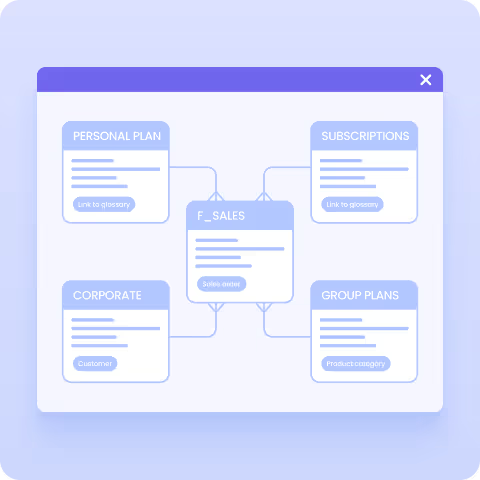
For example, a single customer might represent a corporate subscription, a personal device plan, and the owner of a family plan all at the same time. Who should own the sales & marketing for this individual?
This makes it difficult to:
- Define a customer in the context of analytics.
- Link products and services to specific customer segments.
- Combine and analyze data across product segments.
Aligning Standards with Enterprise Risk
For information and data architects, data models are more than technical artifacts, they are strategic enablers. A well-constructed model:
- Codifies risk taxonomies and exposure definitions
- Supports capital adequacy and reserving processes
- Integrates with enterprise risk systems and regulatory reporting pipelines
-Reduces operational risk through standardized metadata and governance
Ellie.ai: Elevating Your Data Architecture
At Ellie.ai, we empower insurers to operationalize data modeling within risk, compliance, and enterprise architecture initiatives. Our solutions help you:
- Translate regulatory requirements into governed data structures
- Maintain model consistency across multi-domain business contexts
- Embed compliance and risk controls at the source
- Accelerate time to regulatory reporting with rigor and clarity
Build resilient architectures. Govern with confidence. Lead with clarity.
With Ellie.ai, your data model becomes a strategic asset — strengthening risk management and ensuring compliance in a dynamic regulatory environment.
Why Ellie


01
Modeling Your Enterprise Data Product


Design Business-Driven Enterprise Data Products
The answer to these problems is in designing data products within the larger context of business expertise.
This requires your data team to collaborate with domain experts, bridging the gap between business and IT.
We bridge this gap between business and technical teams by providing a purpose-built platform to model enterprise data products.
02
Focus on Business Domains

Define Intangible Concepts, Ensure Data Interoperability
You can:
- Build a common glossary.
- Design modular, reusable data products.
- Iterate on complex data models & data products.
It’s easy for business users to collaborate on Ellie, while technical teams can push these collaborative models into production within the same platform.
03
Frameworks to Reality

Leverage Industry Frameworks, Layer Over Real Data
What you now have is the ability to layer your existing data within a framework.This enables you to build a model that works — the best practices of a framework applied to real-world data.
You can accurately capture the essential structure of data without getting stuck in the details of how the source system organizes it.
Integrations & Open API Access