


Modeling Data Around Service is Complex
Massive service operators, like telecom companies or financial services, generate incredible amounts of interconnected data.
However, creating a coherent enterprise data model can feel impossible with products and customer structures that are often intangible and sophisticated.
Modeling Your Services & Products
Working with Intangible Product Structures
An insurer or a telecom operator has to deal with intangible concepts. Like terms, renewals, coverage, bundles, etc.
While central to your operations, their meaning is not intuitively understood by all. This “intangibility” often results in:
Misaligned Definitions: Teams define & use terms inconsistently.
Disconnected Views: One unit might see a feature as a product, while another treats it as a configuration.
Complex Relationships: Customers often interact with the same product type across multiple channels, in different ways.

Working with Intangible Product Structures
An insurer or a telecom operator has to deal with intangible concepts. Like terms, renewals, coverage, bundles, etc.
While central to your operations, their meaning is not intuitively understood by all. This “intangibility” often results in:
Misaligned Definitions: Teams define & use terms inconsistently.
Disconnected Views: One unit might see a feature as a product, while another treats it as a configuration.
Complex Relationships: Customers often interact with the same product type across multiple channels, in different ways.
Modeling Your Customer Segments
Complicated Customer Hierarchies
Customer relationships in service industries are intricate, with overlapping transactions.
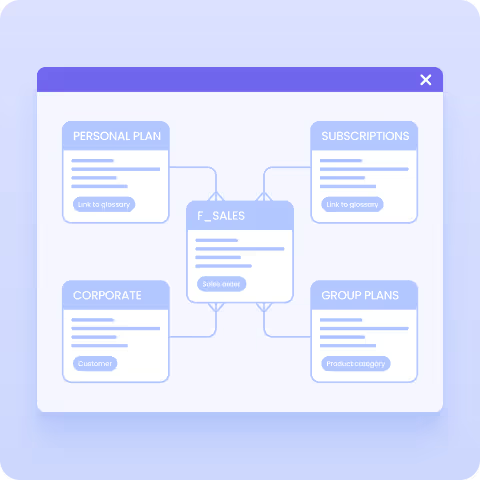
For example, a single customer might represent a corporate subscription, a personal device plan, and the owner of a family plan all at the same time. Who should own the sales & marketing for this individual?
This makes it difficult to:
- Define a customer in the context of analytics.
- Link products and services to specific customer segments.
- Combine and analyze data across product segments.
Complex Customer Hierarchies
Customer relationships in service industries are intricate, with overlapping transactions.
For example, a single customer might represent a corporate subscription, a personal device plan, and the owner of a family plan all at the same time. Who should own the sales & marketing for this individual?
This makes it difficult to:
- Define a customer in the context of analytics.
- Link products and services to specific customer segments.
- Combine and analyze data across product segments.
Modeling Based on Industry Standards
Relying on International Standards for Scalability
One solution to these problems is the use of industry frameworks.
For instance TM Forum (telecom) or the International Organization for Standards (e.g. ISO20022 for financial institutions) has published standard business definitions and the connections between these entities to create a business or semantic layer.
However, these often break down when applied to real-world operational data. An enterprise data platform remains as complicated as without a framework if you cannot adapt these standards to your unique needs.
Relying on International Standards for Scalability
One solution to these problems is the use of industry frameworks.
For instance TM Forum (telecom) or the International Organization for Standards (e.g. ISO20022 for financial institutions) has published standard business definitions and the connections between these entities to create a business or semantic layer.
However, these often break down when applied to real-world operational data. An enterprise data platform remains as complicated as without a framework if you cannot adapt these standards to your unique needs.
Why Ellie


01
Modeling Your Enterprise Data Product


Design Business-Driven Enterprise Data Products
The answer to these problems is in designing data products within the larger context of business expertise.
This requires your data team to collaborate with domain experts, bridging the gap between business and IT.
We bridge this gap between business and technical teams by providing a purpose-built platform to model enterprise data products.
02
Focus on Business Hierarchies


Define Intangible Concepts, Ensure Data Interoperability
You can:
- Build a common glossary.
- Design modular, reusable data products.
- Iterate on complex data models & data products.
It’s easy for business users to collaborate on Ellie, while technical teams can push these collaborative models into production within the same platform.
03
Frameworks to Reality

Leverage Industry Frameworks, Layer Over Real Data
What you now have is the ability to layer your existing data within a framework.This enables you to build a model that works — the best practices of a framework applied to real-world data.
You can accurately capture the essential structure of data without getting stuck in the details of how the source system organizes it.
User Access Roles
Integrations & Open API Access


Plus, use our API to build connections with ease.

.svg)

%201.svg)
.svg)


