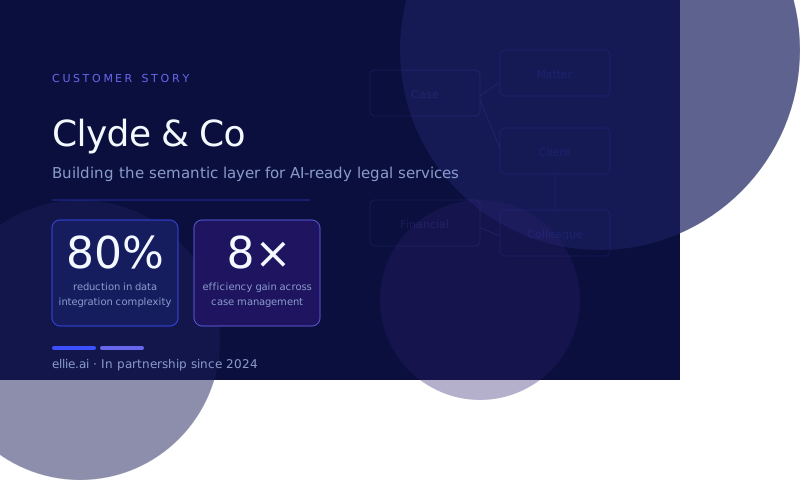

Since 2024, Clyde & Co has been using ellie.ai to design, govern, and activate data across the firm replacing fragmented tools with a single semantic layer that today powers a live enterprise platform, daily design workflows, and the firm’s road to AI.
Clyde & Co is a global, sector-focused law firm with operations spanning regulated industries across multiple jurisdictions. As the firm scaled its data ambitions — consolidating systems from mergers and acquisitions, aligning business definitions across practice areas, building toward governed analytics — one thing became clear: the tools being used to design and communicate data architecture were not keeping pace.
Architectural concepts lived in Visio files. Field definitions were scattered across spreadsheets. Stakeholder alignment meant rebuilding the same logic in PowerPoint for every audience. With engagement required across CIO leadership, risk, information security, data engineering, and business analytics teams, the overhead of translating between representations was compounding fast.
That was the environment in early 2024, when Clyde & Co began its journey with ellie.ai.
When ellie.ai was introduced at the start of 2024, Clyde & Co was in the early stages of designing Clyde Data Services (CDS) — a firm-wide platform designed to integrate and govern colleague, client, matter, case, and financial data drawn from disparate systems. The technical foundation was in place: SQL Server reporting, Power BI, and an Azure Synapse Analytics build. What was missing was a structured way to design and communicate the architecture that would connect them.
ellie.ai became that design layer from day one. Rather than continuing to produce static documents that required constant re-translation, the team built structured domain models directly in ellie — capturing entities, relationships, and hierarchies in a single shared environment that could speak to engineers, architects, and business stakeholders alike. Design became iterative and live, not a handoff artefact.
Through the second half of 2024, those models became load-bearing. The Case domain — the firm’s most complex data area — was fully modelled as a three-level hierarchy that unified business terminology across the firm. By the end of 2024, the initial doma[1.1]in model was ready. In January 2025, Clyde Data Services went live, consolidating several hundred thousand cases from multiple case management systems through metadata-driven integration.
With CDS live, Clyde & Co turned to the next phase of the journey it began in 2024: structured domain expansion across the firm. To support this, the team developed Data Cartography — a novel four-phase framework for how data domains are explored, defined, governed, and deployed as business products. ellie.ai is the design environment at every stage.
Models built in ellie are not documentation artefacts — they are the live working surface through which domains are discovered, defined, and activated. This makes ellie.ai the connective layer between governance intent and delivery outcomes, and the foundation on which the firm’s AI capabilities will be built.
At the practitioner level, the impact of more than a 6 months with ellie.ai is equally visible. Mark Lancaster, Data Design Lead, has used ellie.ai since October 2025 to map, align, and communicate how case data is structured across multiple case management platforms — each with its own implementation of the same underlying business concepts.
Before ellie.ai, that work required assembling information from PowerPoint, spreadsheets, and diagramming tools, and reconstructing the same logic from scratch for each new audience. Now it lives in a single model. Entities, fields, and cross-system relationships are defined once and held in ellie — the live reference point for engineering conversations, stakeholder discussions, and design reviews.
The cumulative effect of more than a year of daily use: an 8:1 efficiency gain. Structures defined once are applied consistently across multiple platforms. The picture no longer needs rebuilding — it’s already there.
“It’s become my essential daily carry — the one constant across everything I do. I use it to build models, explain logic, validate assumptions, and respond to questions throughout the day. ”
— Mark Lancaster, Data Design Lead, Clyde & Co
What Clyde & Co has been building since 2024 is not, at its core, a data platform project. It is the construction of a universal semantic layer — a governed, shared understanding of what data means, how it is related, and who is responsible for it across the firm. That layer is the prerequisite for everything that follows: consistent analytics, AI-powered workflows, intelligent search, and data products that genuinely reflect the complexity of legal operations.
AI systems are only as reliable as the semantic layer beneath them. Firms that invest in that layer as a deliberate, sustained programme — as Clyde & Co has done since 2024 — are not simply solving today’s data governance problems. They are building the infrastructure that makes AI trustworthy at scale. The firm’s Data Cartography framework, with ellie.ai at its centre, is one of the most structured approaches to this challenge we have seen in professional services.
Looking ahead, the partnership will expand into ontologies and knowledge graphs, deepening the semantic foundation that has been built over the past year and opening the next chapter of AI-enabled services at Clyde & Co.
Ellie Technologies is proud to have been part of that journey since the beginning.