
Ask any information architect where data projects go wrong and you'll hear the same answer: the model diverges from the business. Not because the architects aren't skilled, they are, but because the people who understand the business are locked out of the conversation. Business analysts write requirements in Word documents. Data engineers translate those into schemas. Something always gets lost.
AI doesn't just speed up that process. At its best, it dissolves the wall between the people who understand the business and the people who understand the data. ellie.ai has been building toward that vision, and the results are showing. Recent case study with a leading global law firm reported significant performance boost from modeling with ellie.
Semantic data models are extraordinarily precise instruments. They encode decisions that have downstream consequences for years. But their traditional audience, data architects working in specialist tools, often alone, means those decisions get made without the people most affected by them. Product owners can't interrogate a complex entity-relationship diagram. Finance teams can't spot when a revenue definition doesn't match how the business actually recognises revenue.
The result is the modeling paradox: the most important documentation in a data organisation is also the least read. ellie.ai's contextual AI assistant changes that dynamic directly.
"Business users shouldn't need a data degree to ask whether the model reflects how the company actually works."
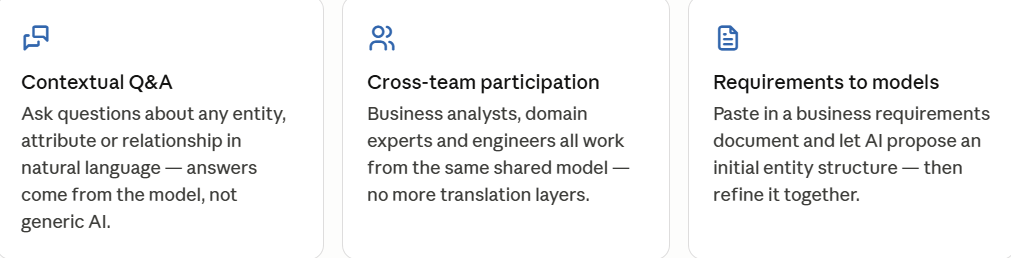
With ellie.ai's built-in AI chatbot, anyone in the organisation can interrogate a model in plain language. A CFO can ask "how is customer lifetime value defined here?" and get an answer drawn from the model itself, not a ticket to the data team. A product manager can ask "what happens to order data when a customer is deleted?" and understand the implications before the feature ships. This isn't a search bar bolted onto a diagram. It's contextual: the AI understands the model's structure, the relationships between entities, and the metadata that architects have attached to each element.
Not only does the data model be understood by humans, but the new agentic AI systems, workflows and tools need context to increase accuracy. Governed semantic data models can provide just that context and significantly boost the quality of answers and referencability.
One of the most time-consuming moments in any data project is the gap between "here are the business requirements" and "here is an initial model." That gap is where scope drifts, where assumptions harden into undocumented decisions, and where stakeholders disengage because they can't see anything yet.
ellie.ai can generate an initial conceptual model from a requirements document. Feed it a brief, a product spec, a process description, a regulatory requirement and the AI proposes entities, attributes and relationships. It's not a finished model. It's a conversation starter that takes minutes instead of days and weeks, and that business stakeholders can actually read and react to. The architect's job shifts from transcription to curation: challenging assumptions, adding depth, encoding institutional knowledge that no document contains.
This matters most in the early stages of a project, when getting alignment fast has outsized value. A conceptual model shared in day two of a sprint is worth more than a polished physical model shared in week six.
The Model Context Protocol (MCP) represents something genuinely new: the ability for AI assistants like Claude to interact directly with external systems, reading from them, writing to them, reasoning about them, within a single workflow. ellie.ai's MCP Server brings that capability to data modeling.
For data engineers, this means that creating and updating models can happen inside the same AI-assisted workflow they're already using. Describe an entity you want to add, and the MCP server creates it. Ask to add a relationship between two existing structures, and it's done without opening a browser, without context switching. For teams managing large model portfolios, this is a meaningful reduction in friction. Data engineers can also ask questions about the model and compare models to actual designs in Fabric, dbt and other tools.
For architects, it means that AI agents can be given modeling tasks autonomously. Migrating a domain from one model to another, copying a set of entities with their relationships intact, generating a database creation script from a finished model these are operations that previously required careful manual execution. With MCP, they become tasks you can describe in plain language and execute with confidence.
"MCP turns ellie.ai from a modeling tool into a modeling participant. Something the rest of your AI workflow can reason about and act on. Imagine a workflow built with 8n8 that picks an ellie.ai conceptual model, aligns with internal documentation, policies and creates a logical data vault model back into ellie."
Most organisations don't start with a blank canvas. They inherit databases built across decades, schemas migrated from deprecated tools, structures that encode decisions nobody remembers making and operational systems such as ERP and CRM inherited from acquisitions. Reverse engineering turns those artifacts back into physical models but historically, the output has been structural without being semantic. You get the tables and columns, but not the meaning.
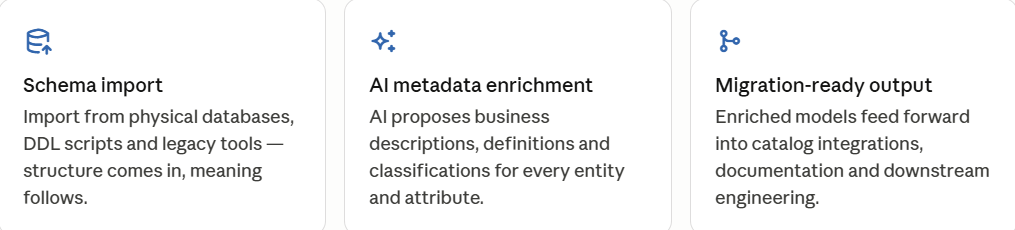
AI-assisted metadata enrichment changes that. When ellie.ai reverse engineers a system, the AI can propose business descriptions for entities and attributes based on naming conventions, contextual patterns, and domain knowledge. A table called cust_acct_xref becomes a documented entity with a human-readable description and suggested relationships. An attribute called eff_dt gets labelled and contextualised. Data modeler can later validate synthetic metadata and tags making them part of the overall documentation.
This is especially valuable in migrations such as moving from SAP PowerDesigner, from legacy ERD tools, from custom schemas where the goal isn't just to recreate structure but to recover the intent behind it. The AI doesn't replace the architect's judgment. It does the first pass: proposing, surfacing, suggesting. The architect validates, corrects and enriches. The result is a model that actually documents what the system means, not just what it contains.
Once the reverse engineered source systems are in the ellie.ai repository, AI agent can assist the modeler find relevant tables to leverage them in the models while maintaining the lineage data. It's a massive improvement to productivity when you can find the right needle in the haystack of needles by asking a question such as "show me the tables that address customer profitability."
The modeling process has always been too important to be left only to modelers. The decisions encoded in a semantic model shape every downstream system, every report, every AI application built on top of that data. Those decisions deserve the participation of everyone who understands the business.
AI doesn't lower the bar for good modeling. It lowers the barrier to participation. That's a meaningful difference, and it's what ellie.ai is building toward.